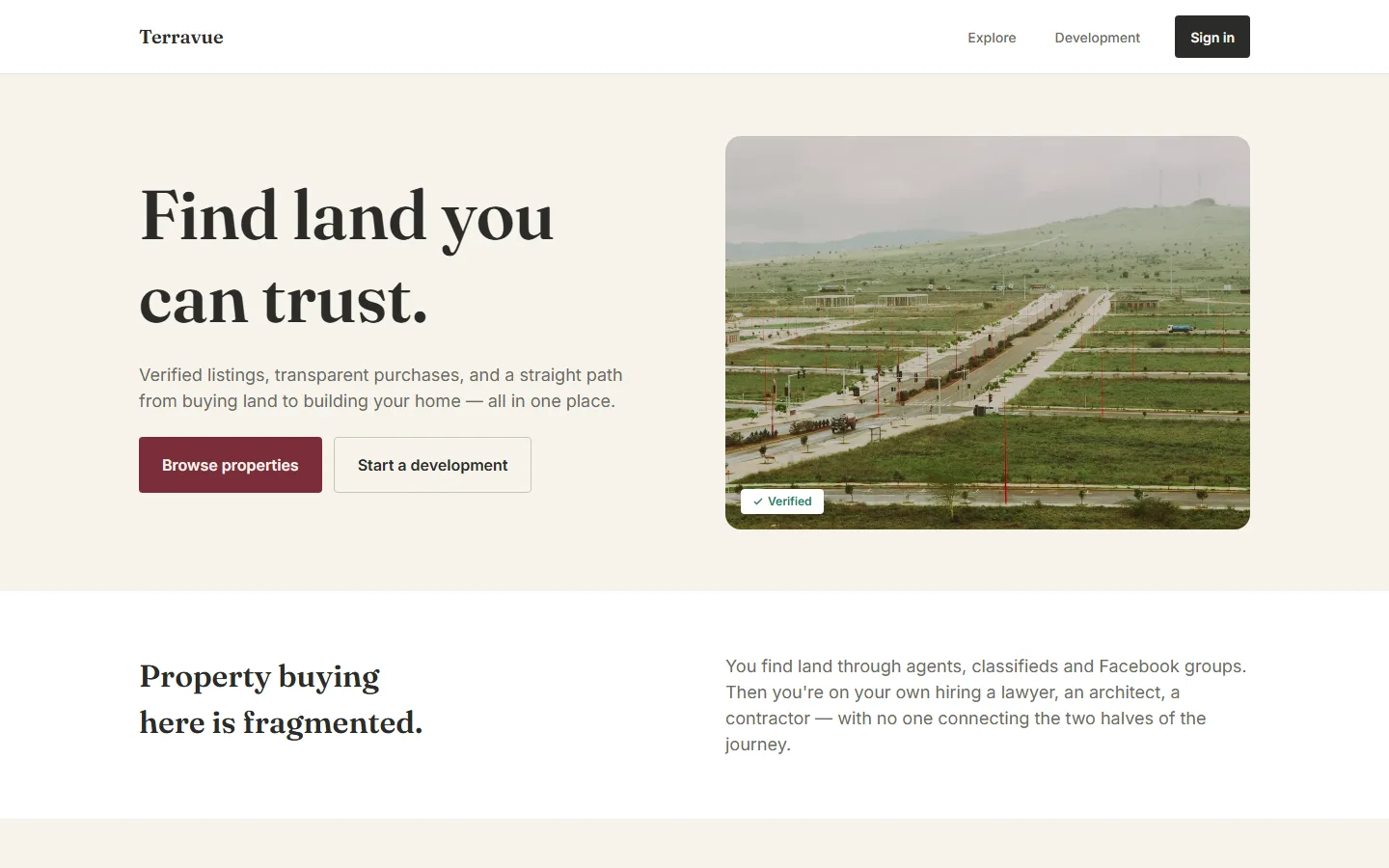
A trust-first property platform for Dhaka — verification earned and visible before purchase, and a relationship that continues past the sale into development.

Property buying in Dhaka is fragmented across agents, personal contacts, Facebook groups and classifieds. Buyers have no way to verify a listing is genuine before committing, and no continuity between buying land and actually building on it. The brief: design a platform where verification is earned and visible before purchase, and where the relationship continues past the sale into development — so buying the property is the start of the relationship, not the end.
I set the brief and the target user — a family buying a home, a high-stakes, low-frequency decision, someone who wants proof, not persuasion, after being burned by informal agent and Facebook-group buying — before any screen work started. I locked the payment rails myself: bank transfer, card and Bangla QR, deliberately excluding bKash and Nagad, because transaction sizes here run up to ৳86,00,000+, past what mobile financial services are built to carry. That's a business-logic call, not a design preference.
Home, Explore, Property detail, Enquiry, Login, and the complete Purchase flow — review, verification, payment, success/failure.
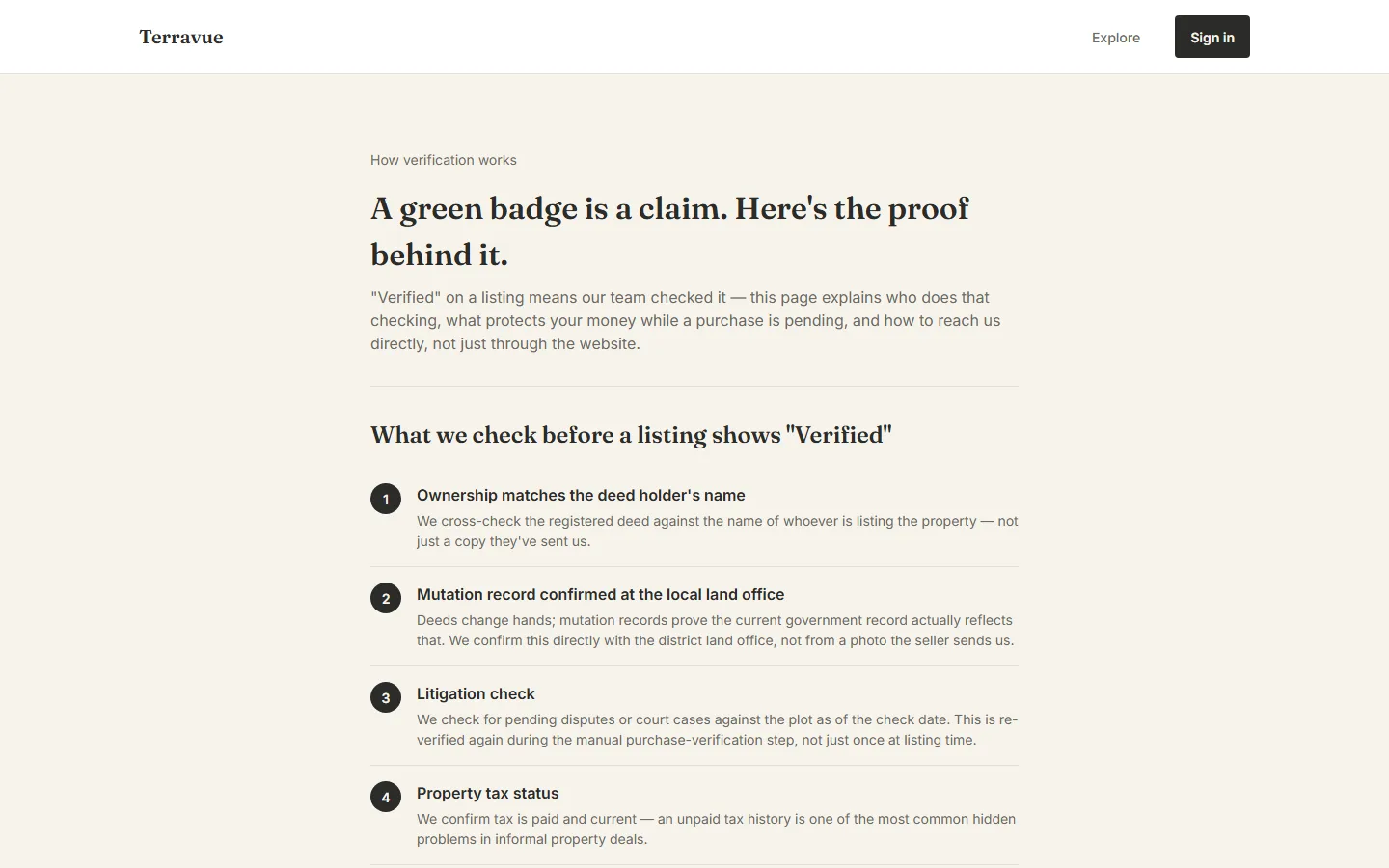
"How verification works," added after critique surfaced that a badge alone wasn't enough — see below.
Ran /design-review, /heuristic-evaluation and /persona-acid-test against my own build and fixed every finding myself, in-browser: 11 design-review findings, 9 heuristic findings, 3 persona findings.
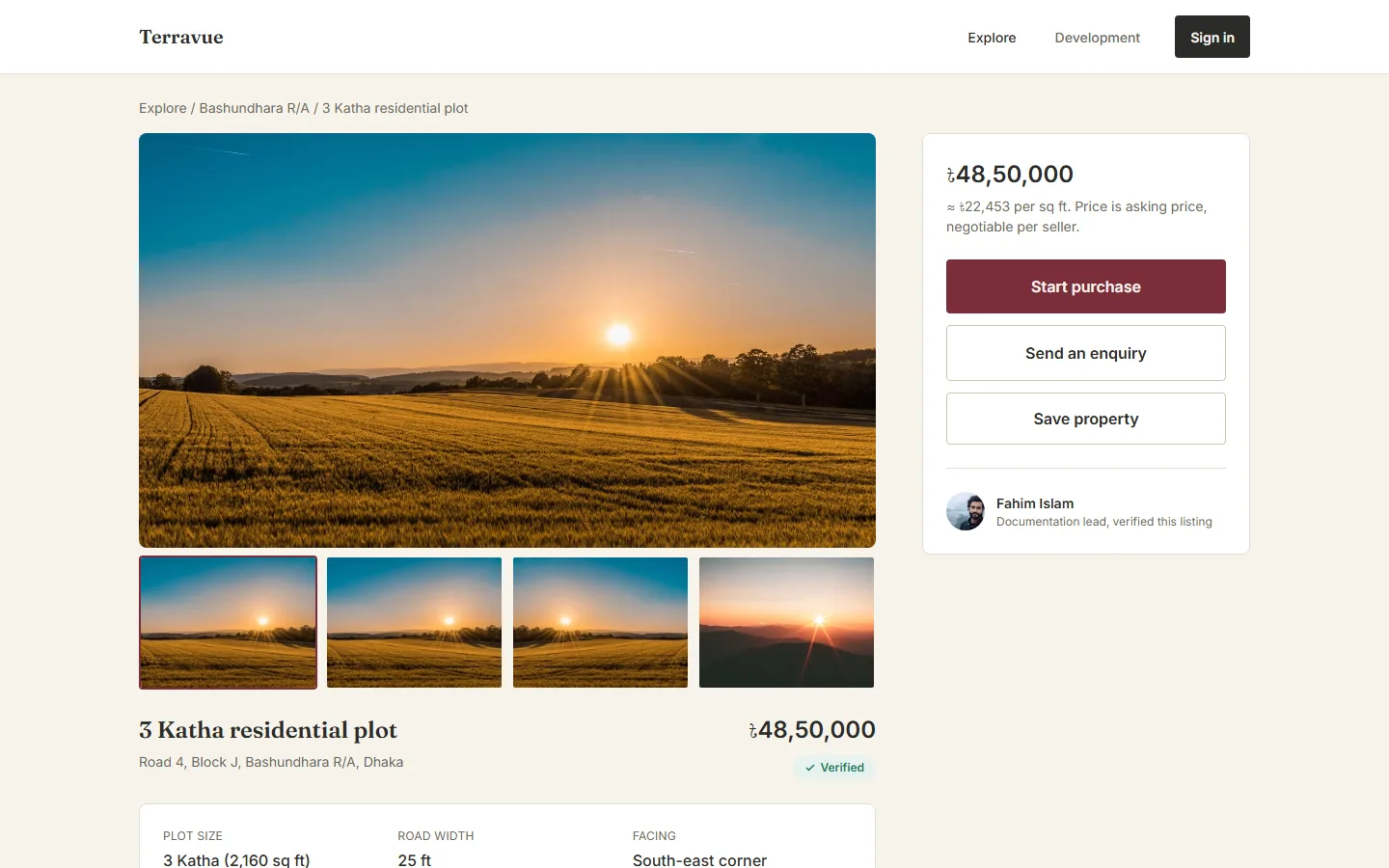
Property detail — the trust-check decision moment.

"How verification works" — added after real critique, not my own first pass.
The obvious problem was "people don't trust listings." The real problem, which only surfaced under outside critique, was that a "Verified" badge only proves a listing was checked — it says nothing about whether Terravue itself is accountable, or what happens to a customer's advance payment if the deal falls through.
"No one cares about Terravue or Verified by Terravue... there is no proof or authentication process shown that you are not a scam."
I turned that into two functional requirements — real names and roles behind verification, and a findable refund/accountability policy — and built the trust page to answer them at the two moments they matter most: the property-detail trust-check, and the purchase-review payment commitment.
I rejected my own first payment-method selector after a friend tested it on his phone — Card and Bangla QR were gray underlined text with no visible button boundary, so they read as labels, not controls. I rebuilt it as a bounded 3-button group matching a pattern already established elsewhere on the site, instead of inventing a new one.
I also rejected my own instinct to build a full milestone/document-tracking dashboard for the post-purchase "My Purchase" page. It was in the original brief, but a Gantt-style progress console was more product than this stage of Terravue needed — I descoped it to a plain status summary and logged the decision, rather than build something impressive the product wasn't ready to support.
Live at Terravue, the full trust story working end to end, verified in-browser, not just claimed. It held up under a real person testing on mobile and under critique from someone more experienced — I fixed what both found rather than defending the first version.
The brief names property enquiry conversion as the primary success metric — the thing that proves the discovery-and-trust experience actually works. But when it came time to polish and critique-fix a flow in depth, I put that effort into Purchase instead, the secondary flow. Enquiry is still the plainer, less-tested screen on the site. I didn't catch this myself — the persona acid test's "impatient PM" lens caught it. I've left it as a known gap rather than quietly fixing it after the fact.