← All work Case study · Self-initiated

Dhaka Metro Companion

A Bangla-first tool for MRT Line 6 that answers the one question the official app doesn't: when do I actually need to leave?

RoleProduct design and build, solo
Built3-screen offline web app (PWA)
StatusWorking build · live
StackHTML, CSS, JS · no backend
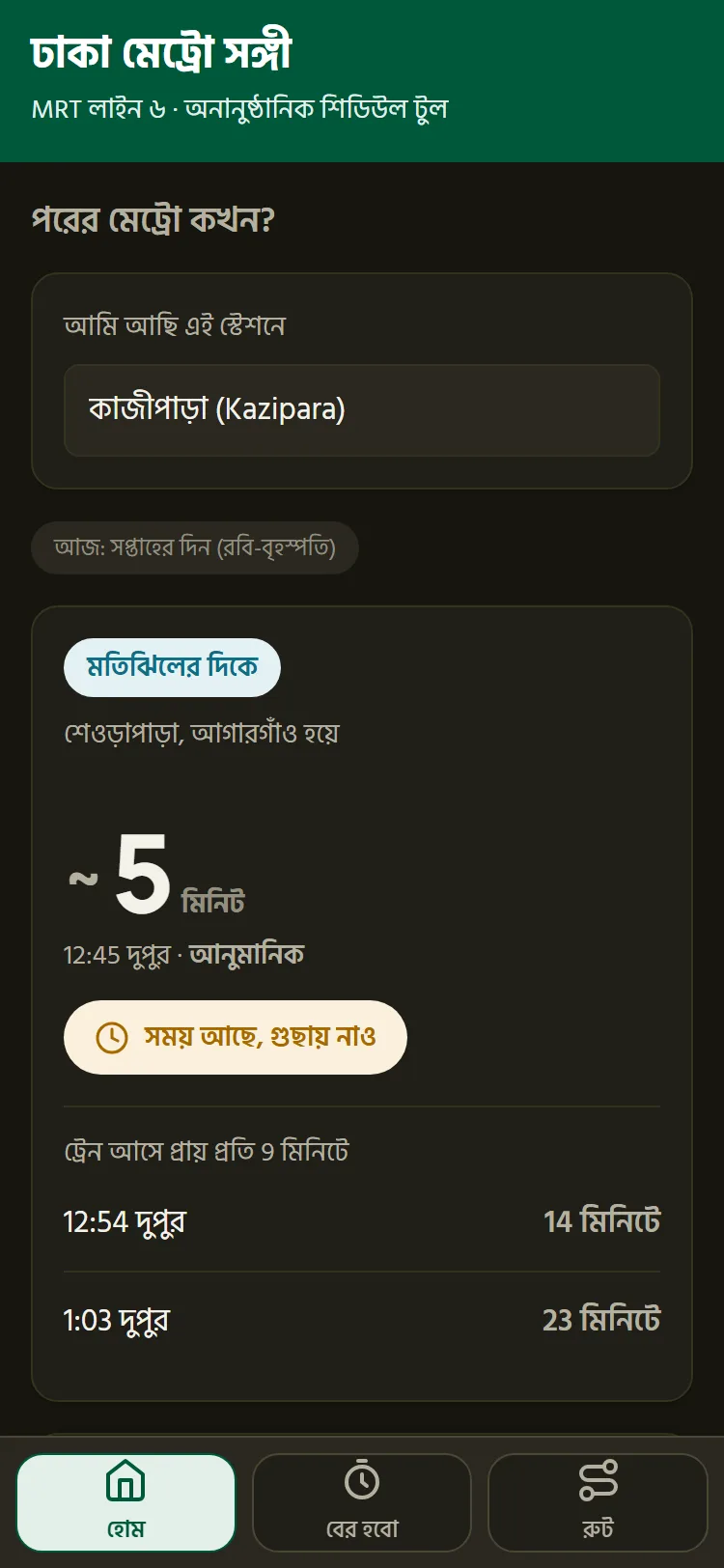
Home screen: next train toward Motijheel in about 5 minutes, marked as an estimate, with an amber 'time to spare, get ready' state chip
Home: the next train, and what to do about it
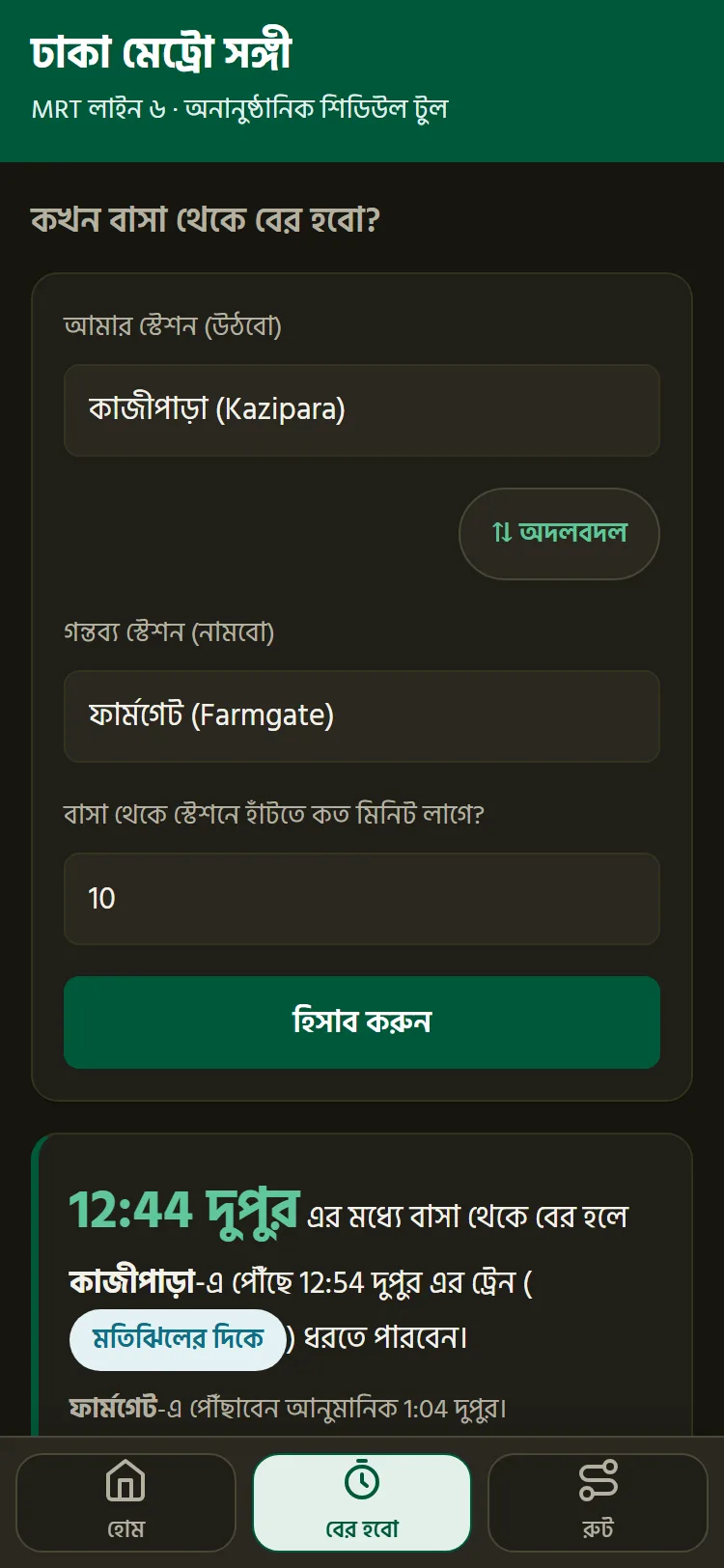
Leave-time calculator: leave home by 12:44 to catch the 12:54 train from Kazipara to Farmgate
Calculator: when to leave home
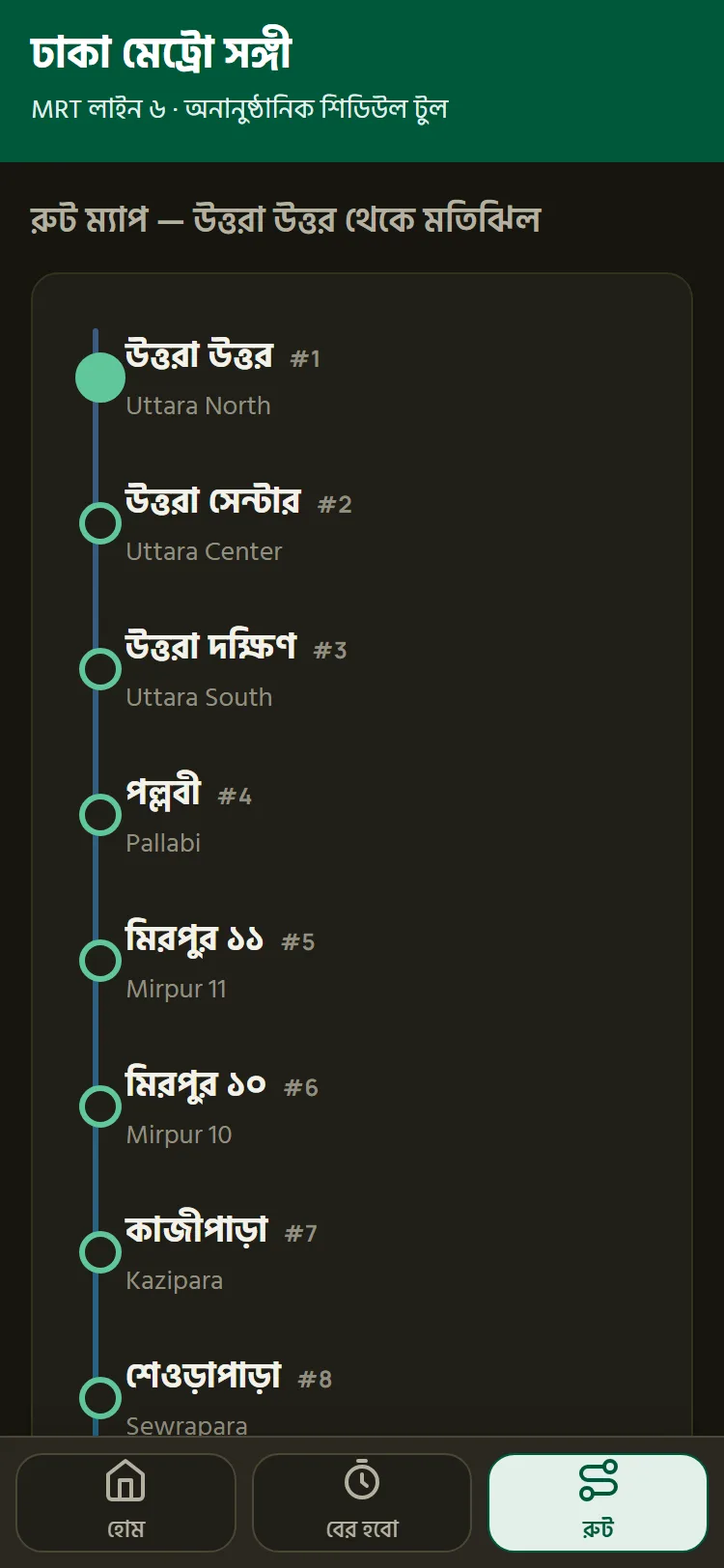
Route map of Line 6 stations in Bangla and English
Route: 16 stations, Bangla and English
01

The brief

I ride Line 6. The official DMTCL app handles card top-up and tells me which station I'm at, and I still use it for that. What it doesn't do is tell me when to leave home, or whether I have time to spare once I'm at the station. That gap is the whole reason this exists: it isn't competing with the official app, it fills the one hole in it.

I was my own client, so I ran the process on myself: interrogate the brief before designing anything, write it down, then build.

02

The real problem

My first brief said "show the next train time." Stress-testing it showed that was a lookup, not the job. The real job is two decisions per trip: a rough "when do I leave home" before I set off, and then, standing at the station, "do I go up to the platform now, or do I have time for tea or a card top-up first?"

A bare number doesn't answer the second one. "6 minutes" still leaves you doing the maths. So the countdown had to become an instruction:

7+ minযথেষ্ট সময় আছে

Plenty of time. Tea, top-up, come back.

3 to 7সময় আছে, গুছায় নাও

Time, but start moving.

< 3এখনই যাও

Go now. Don't risk it.

03

What I built

Designed for how it's actually used: one-handed, mid-walk, on a mid-range Android on mobile data. I wrote the brief, IA and tokens myself, then directed AI to build from them, and checked every screen in a real browser rather than trusting the code.

State chip, never colour alone

Each tier carries an icon, a Bangla label and a colour, so it still reads in sunlight or for someone colour-blind.

Two colour families that never mix

Direction badges are blue and teal; state chips are green, amber and red. One-handed at a glance, "which way" and "how urgent" can't be confused.

Last station, not a favourites list

My station changes day to day, so the app remembers the last one used instead of asking me to set a fixed "home station".

Works offline, tracks nothing

Static schedule data, installable, runs with no signal once loaded. No accounts, no backend, no analytics.

Numbers that render

The display font had no Bangla digit glyphs, so big numbers silently fell back to a random system font. Numbers are Latin digits now; station names keep their Bangla numerals.

04

What I rejected

Fake precision. The first build came back with a five-band timetable of train intervals that didn't match any source. When I researched DMTCL's real numbers, they turned out to be unstable across reports. With no live feed, chasing exact minutes would only look accurate. I cut it to three honest values (7, 9 and 12 minutes) from my own commute pattern, and documented them as estimates.

A vibration alert for "go now". Useful, but reliable alerts with the screen locked need a server. That breaks the no-backend constraint, so it went to v2.

Moving the nav to the top. The bottom tabs were hard to see, and my first instinct was to move them. The real cause was contrast, not position. I fixed the contrast and kept the tabs where a thumb reaches.

05

Reviewing my own work

I ran three reviews on the finished app as if it were someone else's: a design review, a Nielsen heuristic evaluation, and a three-persona stress test (confused first-time rider, sceptical engineer, impatient PM).

The heuristic evaluation gave one Fail, and it was the core feature. The countdown said "5 মিনিট" with total confidence, but the intervals under it were my estimate. The fix keeps the useful number and says what it is: "~5 মিনিট · আনুমানিক", plus "a train comes about every 9 minutes" under it.

Checking the fixes turned up more: dark-mode green text at 1.9:1 contrast (the standard is 4.5:1), including on the calculator's main answer. Then I ran the app on the real clock at 6 AM, and it showed Kazipara's first train at 6:30. That's when it leaves Uttara North; it reaches Kazipara at 6:42. The official last train was also dropping out of the list. All fixed and re-tested.
06

Outcome

A working offline app for my own commute, built end to end from brief to review. It isn't public yet: next is a field check of the estimate against real departures before anyone else relies on it.

16stations, Bangla and English
3reviews run on my own work
0servers, accounts or trackers
What I got wrong

I shipped a countdown that looked exact while the data under it was a guess. It passed my own design review, because that review checked whether the screen looked right, not whether it was honest. Only a structured heuristic pass caught it. Now, whenever a number is computed rather than known, the interface says so.

Next case study GaariHaat →